A corner sofa is a fundamentally different piece from a straight sofa, and rooms that contain one require a different approach to design. The corner configuration introduces a seating form that occupies two walls rather than one, defines a zone rather than simply filling it, and creates a spatial boundary that divides the room into a seated interior and an open exterior. These properties are not inherent advantages. They become advantages or disadvantages depending on whether the positioning, coverage, and supporting decisions are made correctly.
When they are made correctly, a corner sofa produces a living room that functions better than the same room with a straight sofa: more enclosed at the seating zone, more clearly defined in its spatial logic, and more versatile for different kinds of occupation across the day. When they are not, it produces a room that feels blocked, over-furnished, and difficult to navigate.
Positioning the corner and what it controls
The position of the corner element within the sectional determines the spatial logic of the entire seating arrangement. A corner that sits flush against both walls produces the most enclosed zone: the occupants face into the room from a protected position, which reads psychologically as comfortable and secure. A corner that floats away from the walls introduces a more casual spatial logic, where the sofa defines its own zone without reference to the room’s architectural boundaries.
For most living rooms, the wall-positioned configuration produces a more satisfying result because it uses the room’s existing architecture to create enclosure rather than requiring the furniture to generate it independently. The corner of the room becomes the centre of the seating zone, and the two arms of the sectional extend along the walls to create a generous, defined space that is neither too formal nor too casual.
The chaise or open end of the configuration is the element that most directly affects circulation. It should always point toward the main movement path in the room rather than across it. A chaise that extends into the primary walking route between the sofa and the kitchen or hallway makes daily movement through the room an obstacle course. One that extends along the wall or parallel to the main route allows unimpeded circulation and also functions better as a lounging surface, because it faces into the room rather than toward the wall.
The cover and the corner element
The corner piece of a sectional sofa presents the most technically demanding upholstery challenge in the configuration. It is a three-dimensional form rather than the essentially two-dimensional surface of a straight section: it wraps around a 90-degree angle, must accommodate the meeting of two back sections as well as a continuous seat surface, and must do all of this while lying correctly under tension without bunching at the internal corner or pulling at the external one.
A generic slipcover typically handles this challenge poorly because the corner geometry requires pattern pieces that are specific to each sofa model’s proportions. The Söderhamn’s corner section has a defined geometry that is not interchangeable with that of other IKEA models or with generic size categories. A cover made for it specifically will sit correctly in a way that a cover made for a notional size range cannot.
For this reason, model-specific fit is the primary requirement for any corner cover. IKEA Söderhamn corner slipcovers made to the specific dimensions of the Söderhamn’s corner section address this challenge directly: the cover lies correctly at the internal angle, does not bunch or bridge at the external corner, and maintains the visual continuity of the fabric across all three sections of the piece. In a natural fabric with a visible weave, this continuity is critical for the finished piece to look considered rather than assembled.
Matching fabric across sections
When a sectional configuration includes covers from the same production run in the same fabric, the visual continuity of the weave across sections contributes to the perception of the sofa as a single, unified piece rather than a collection of assembled modules. This matters particularly with linen and other fabrics that have directional weave patterns: where the grain runs consistently from section to section, the sofa reads as resolved. Where it shifts, the modular origin of the piece becomes visible.
How do decor and styling alter the perception of the corner zone?
A corner sofa creates a defined zone in a room, but the boundary of that zone is a social and perceptual construction as much as a physical one. The objects, surfaces, and lighting positioned within and around the zone reinforce or weaken the sense of enclosure and comfort that the sofa’s form establishes.
A December 2024 study published in Buildings used eye-tracking technology to measure how décor elements shift visual attention and spatial perception in a living room environment. The research found that strategic décor placement redirects attention and changes how a room’s architecture is experienced, with styling decisions capable of making key architectural features more or less prominent depending on where objects are positioned. For a corner sofa arrangement, this finding translates directly: the objects placed within and around the seating zone influence whether the corner reads as a considered destination or as an area that happens to contain a large piece of furniture.
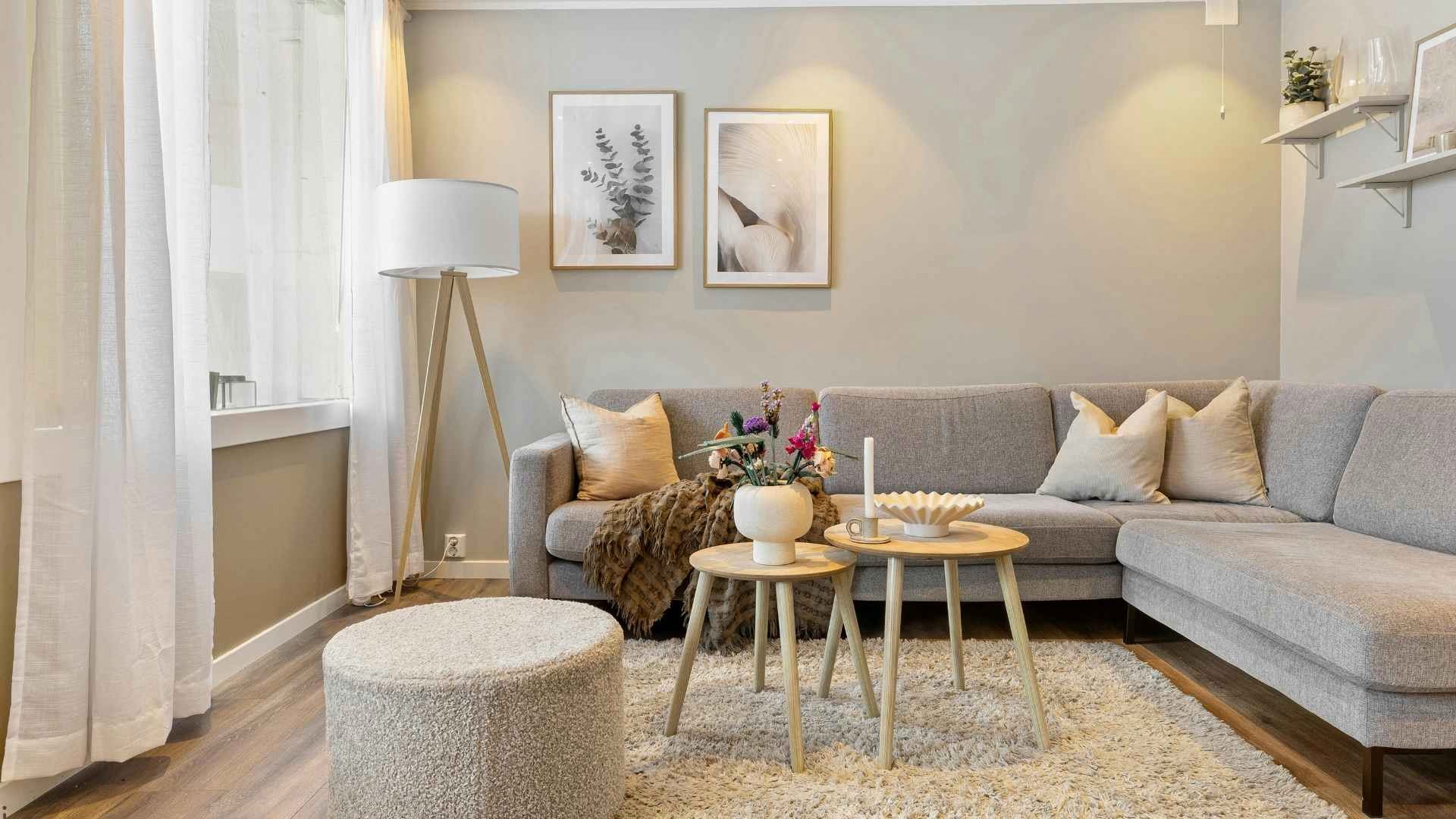
The objects that most consistently strengthen the corner zone are those that define its boundaries without physically blocking them. A floor lamp at the external end of the chaise marks the limit of the seating zone and provides the warm, low-angled light that rest and reading require. A low coffee table positioned in the interior of the angle provides a functional surface that also anchors the zone spatially. A rug that extends under all sections of the sofa defines the floor plane of the zone and visually separates it from the rest of the room.
The rug and what it does for a corner configuration
The rug decision in a room with a corner sofa is among the most consequential spatial choices available, and it is one where the most common error is choosing a rug that is too small. A rug that fits only under the coffee table, or only under the straight section of the sofa, fails to define the zone and instead reads as an accessory that happens to be near the seating area.
For a corner configuration, the rug should be large enough that all sections of the sofa have their front legs resting on it. This means a considerably larger rug than most people default to: for a full Söderhamn corner configuration, a rug measuring 250 by 300 centimetres or larger is typically needed to achieve this. A rug of this size may seem excessive in isolation, but in context it produces the spatial definition that makes the corner arrangement read as a room within a room rather than a sofa in a room.
Natural fibre rugs in wool or jute are preferred for this application because they provide the acoustic softness that a corner zone benefits from and because their visual character relates well to the natural fabric of the sofa cover. A synthetic rug in a geometric pattern would compete visually with the organic texture of a linen sofa in a way that a natural wool or jute alternative does not.
Cushions and the functional use of the corner piece
The corner piece of a sectional sofa is often underutilized. Because it faces into the interior angle rather than outward, sitting in it directly provides a different seating experience from the arms of the sofa: one that is more enclosed and more supported on two sides, but one that requires a different cushion arrangement to be comfortable.
The corner position works well for solo reading or resting because the two-sided support allows the occupant to lean into either back section without the piece tilting or shifting. A large scatter cushion positioned in the internal angle softens the 90-degree meeting point and makes the corner a genuinely comfortable place to settle. Without this, the internal corner tends to feel sharp and unsupported, which is why corner pieces are so often left unoccupied even when the rest of the sofa is in use.
The cushions on the corner piece should match the sofa cover fabric in at least one element: either the same fabric or the same tonal range. Cushions that read as entirely separate from the sofa cover make the piece look as though it has been accessorized rather than considered, and the visual incoherence between the sofa surface and the scatter cushions reduces the overall quality of the arrangement.
Reconfiguring the sectional as the room evolves
One of the genuine advantages of the Söderhamn’s modular design is the ability to reconfigure the arrangement as the household’s needs change. A corner configuration that serves a household of adults well may need to be reconfigured when a family grows, when the household downsizes, or when a move introduces different room proportions.
The cover system accommodates this flexibility in a way that fixed upholstery cannot. If a section is added or removed, the cover for that section is an independent element. If the configuration changes completely, the covers change with it. The fabric investment follows the furniture rather than being tied to one specific arrangement, which means the quality of the upholstery decision compounds over multiple configurations rather than having to be made again from scratch each time.
This is the underlying value of the modular sofa model: it matches the way households actually live, which is not static but evolving across years and decades. The design that serves a household correctly is one that can adapt to those changes without requiring the entire investment to be discarded and remade, and the corner configuration is the element of the Söderhamn that best expresses this adaptability in spatial terms.