Not sure whether to repair or replace a damaged part of your home? Learn how Chicago homeowners can compare costs, identify recurring problems, and make smarter home repair decisions.
Home repairs are rarely as simple as they first appear. Sometimes, a few hundred dollars are enough to solve the problem, and that is the end of it. But sometimes things work differently: you invest in another temporary fix, only to face the same issue a year later—this time with higher costs.
Most homeowners know this feeling all too well. You have just had a faucet repaired, and it starts leaking again. A crack in the drywall is patched, but a few months later, the exact same crack appears in the exact same place. Floor tiles start coming loose one after another. A door refuses to close properly again, even though the hinges have already been adjusted three times. Sound familiar?
The question is almost never whether something can be repaired. It can. Almost anything can be fixed. The real question is whether it makes sense to do so. Is the repair genuinely cost-effective, or are you simply delaying a larger and more expensive project?
These questions are becoming increasingly important for homeowners. Recent data shows that 71% of American homeowners are paying closer attention to preventative maintenance in an effort to avoid higher costs later on. At the same time, 48% say that mandatory home repairs are already a source of stress. What makes that stress even more frustrating is spending money on a solution that turns out to be only temporary.
The age and condition of a property can make the decision even more complicated, particularly in a city like Chicago. Nearly half of owner-occupied homes in the United States were built before 1980, and the median age of a home is now around 41 years. Older properties often come with their own collection of inherited problems: general wear and tear, moisture issues, outdated materials, and repairs completed by previous owners that were not always done properly. As a result, a problem that looks minor on the surface may have a more complicated cause underneath.
Before Deciding Whether to Repair or Replace, Find the Real Cause
What you can see is not always the actual problem.
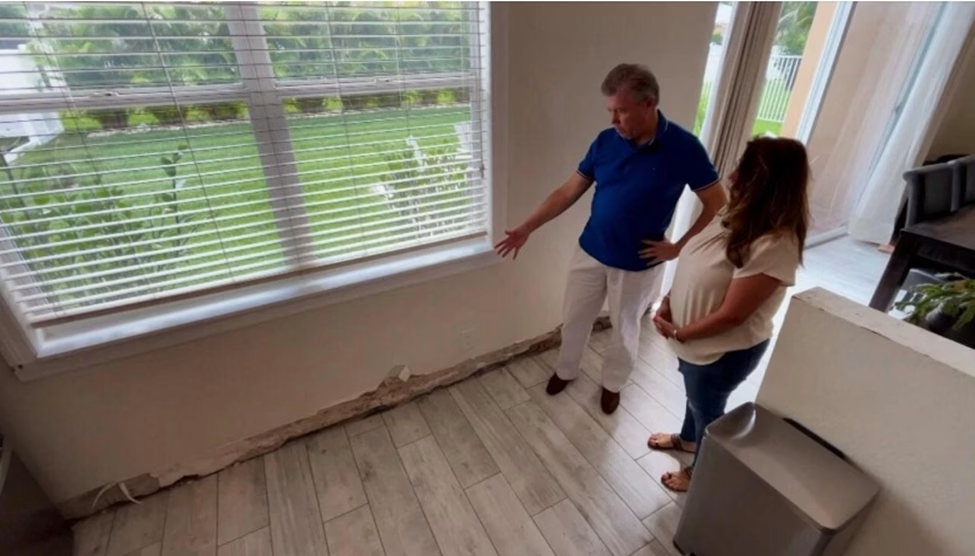
Take a crack in the drywall. If it appeared after an unsuccessful attempt to move a heavy piece of furniture, the solution is straightforward: make a small repair, apply a fresh coat of paint, and move on. But if the crack returns a few months later, it is worth looking deeper. Moisture, structural movement, poor-quality materials, or previous workmanship could all be contributing to the problem.
The same applies to tile. If one tile cracks in an isolated area, replacing it may be all that is needed. But if tiles across an entire kitchen begin cracking or the grout keeps breaking apart, the issue is probably not the tile itself. The problem may be underneath it. Replacing tiles one by one makes little sense if the underlying cause remains unchanged—you will keep spending money without actually solving anything.
This is the point where it becomes important to distinguish between a temporary fix and a real solution. Do not hesitate to ask yourself—or the person doing the work—a few direct questions:
- What actually caused the problem?
- Is this the first time it has happened, or has it occurred before?
- What condition are the surrounding walls, floors, or structural elements in?
- Will the repair address the cause rather than simply hide the visible damage?
- How long is the proposed solution realistically expected to last?
A qualified professional in Chicago should not simply repair what is visible and move on. A good assessment starts with understanding what caused the damage in the first place. Sometimes, a careful repair to part of a wall or replacing a single tile is genuinely all that is needed. There is no reason to replace everything when the rest of the structure is still in good condition.
Compare the Cost of Repair With What You Are Likely to Spend Next
First of all, it is important to understand the root of the problem. But the next step may be even more important: instead of looking only at the cost of repair versus replacement today, think about what you are likely to spend in the future.
This is where homeowners often make mistakes—and it is easy to understand why. A repair costs $300, while a new replacement costs $1,200. At first glance, saving nearly $1,000 seems like the obvious choice. But the calculation changes if that repair lasts only six months. Then something else fails, another service call is needed, and suddenly those initial savings start to look like an illusion.
Take a common example: an old bathroom faucet. Replacing the cartridge once makes perfect sense. The second repair may still be reasonable. But when the faucet itself is starting to corrode, replacement parts are becoming harder to find, and leaks keep coming back, those repeated small repairs can easily end up costing more than replacing the faucet altogether.
The same applies to home repair Chicago projects. What seems like the cheapest solution today can turn out to be far less economical when you look two or three years ahead.
Before making a decision, consider three things:
How much will the repair cost?
How much are you spending right now to solve the immediate problem?
How long is the repair likely to last?
Is it a temporary fix, or is it a reliable solution that could last for several years?
What condition is everything around it in?
Could fixing one problem simply mean that other worn or damaged parts will start causing trouble a few months later?
This approach is especially useful when dealing with older plumbing fixtures, doors, flooring, and other parts of the home that have already required attention more than once.
Replacing a single board in a squeaky floor can be a sensible solution. Replacing an entire floor because of one crack would be excessive. But if the same section of flooring has already been repaired three times and the damage continues to spread, it may be time to admit that the money is no longer going toward solving the problem. Instead, you are paying to keep something going that may already be due for replacement.
There is no magic number that tells you exactly when something should be replaced. It depends on the situation. Spending $200 on a repair that gives you several more years of reliable use can be money well spent. Spending $200 three different times to fix the same recurring problem is a completely different calculation.
This is also why the lowest price is not always the best solution. A good handyman Chicago homeowners can trust should be able to give an honest assessment: “This can be repaired for now, but this other part may need to be replaced soon.”
That does not mean you should always choose the most expensive option or replace an entire system when only one part is damaged. In many situations, a straightforward repair is the best solution. The important thing is to understand what you are paying for and what you can realistically expect from the result.
Sometimes, it makes sense to save money and repair something that still has plenty of useful life left. Other times, it is more cost-effective to spend more once rather than return to the same problem year after year.
The most important thing is not to look at the repair bill as an isolated number. Consider how much you are likely to spend on repeated repairs and ongoing maintenance, then compare that with the cost of replacing the old solution with a new, reliable one. That comparison can help you save not only money, but also a great deal of frustration.
Consider the Bigger Picture, Not Just the Damaged Part
By the time you have identified the cause of the problem and compared the cost of repair with replacement, there is one more thing worth considering: the condition of everything around it.
A damaged item rarely exists in isolation. One cracked tile may be just one cracked tile. But several cracks appearing across the same floor could point to movement in the subfloor. A leaking pipe may need nothing more than a new fitting, or it could be one weak point in an aging plumbing system. The difference matters.
This is particularly important in older homes. According to the National Association of Home Builders, nearly half of owner-occupied homes in the United States were built before 1980. That does not mean an older home automatically needs major repairs. Many older properties remain in excellent condition. However, age can make it more important to look beyond the visible damage.
For example, imagine water damage near a kitchen sink. If only a few floorboards are affected and the subfloor underneath is completely dry and stable, replacing those boards may be all that is necessary. But if water has been leaking slowly for months, the damage may extend further than what is visible. The subfloor, cabinets, or nearby materials could already be affected.
In that situation, replacing the damaged boards alone might make the floor look better, but it would not necessarily solve the problem.
The same principle applies to doors, drywall, plumbing fixtures, flooring, and many other parts of the home. Before deciding whether to repair or replace, it is worth looking at the bigger picture.
Ask yourself:
- Is the damaged item the only problem in this area?
- Have similar issues appeared before?
- Are the surrounding materials still in good condition?
- Could one repair simply reveal another problem a few months later?
- Is this part of a larger system that is already showing signs of age?
This does not mean that every issue requires a complete renovation. In fact, replacing too much can be just as wasteful as repeatedly repairing too little.
Sometimes, a targeted repair is exactly what is needed. Replacing one damaged section of drywall, fixing a loose door, or repairing a small plumbing issue can extend the life of the existing materials for years. The key is to make sure that the problem is genuinely isolated.
For homeowners searching for handyman Chicago suburbs services, the same principle applies regardless of the property’s age or size. When comparing different repair options, it can also be useful to review the range of home repair and maintenance services available at https://fixprosolution comand better understand which type of work may be appropriate for a particular problem.
Ultimately, the decision to repair or replace should not be based on a single number or the appearance of one damaged area. Look at the cause, the history of the problem, the expected lifespan of the repair, and the condition of the surrounding materials.
Sometimes, the smartest decision is a simple repair. Other times, replacing a worn-out component before it causes additional damage can save both money and time.
The goal is not to replace everything that looks old or repair everything simply because it is cheaper today. The goal is to choose the solution that makes the most sense for the condition of the home—and is least likely to bring you back to the same problem again.