Heating and cooling costs make up between 30% and 50% of the average home energy bill, according to the U.S. Department of Energy. For homeowners in Central Florida — where the heat rarely lets up — an outdated or underperforming HVAC system can quietly drain your budget month after month. Planning HVAC upgrades before your system fails puts you in control of the process, the timeline, and the cost. In this guide, we walk through how to assess your current system, choose the right upgrades, maximize energy savings, and build a smart plan that delivers better comfort all year long.
Whether you’re dealing with rising energy bills, uneven temperatures, or a system that’s simply getting old, the steps in this guide apply to most homes and budgets. For homeowners in the Winter Haven area looking for local guidance, Nebula Home Services offers licensed HVAC professionals who can help evaluate your system and walk you through your options — with no-pressure, transparent advice.
Let’s start with the most important question: does your current system actually need an upgrade?
How to Assess Whether Your System Is Ready for an Upgrade
Before spending money on new equipment, it’s worth taking a clear-eyed look at what your current system is actually doing and how well it’s doing it. HVAC systems are built to last, but they don’t last forever. Most systems have a functional lifespan somewhere between 10 and 20 years, depending on how well they’ve been maintained, how hard they’ve been worked, and the quality of the original installation. Air conditioning units that have crossed the 15-year mark are generally considered to be in their final chapter, while furnaces can sometimes push past 20 years before efficiency drops significantly.
That said, age alone isn’t the whole story. A well-maintained 14-year-old system might still be running efficiently, while a poorly installed 8-year-old unit could already be costing you more than it should. Understanding the difference between a system that needs a repair and one that’s ready to be replaced requires looking at performance data, not just the installation date.
Signs Your HVAC System Is Losing Efficiency
There are several warning signs that indicate your system is working harder than it should — and that planning HVAC upgrades may be the smarter financial move compared to continuing to repair an aging unit.
Unusual noises are often one of the first indicators. Banging, rattling, grinding, or squealing sounds during startup or operation can point to worn mechanical components, loose parts, or failing motors. These aren’t sounds a healthy system makes.
Uneven temperatures throughout your home are another red flag. If some rooms are consistently too warm while others feel cold, your system may no longer be able to distribute conditioned air effectively. This can be caused by ductwork issues, a failing blower, or a system that’s simply undersized or over-aged for the space it’s trying to condition.
Rising energy bills without a corresponding increase in usage are a strong signal that your system’s efficiency is declining. As components wear down, the system has to run longer cycles to achieve the same result — and that translates directly into higher monthly costs.
Frequent breakdowns are perhaps the clearest sign that replacement is worth considering. When repair calls start stacking up, the cumulative cost often approaches or exceeds the investment in a new system — without the benefit of improved efficiency or reliability.
Short cycling — where the system turns on and off in rapid, incomplete cycles — suggests the unit is struggling to maintain setpoints. This puts significant strain on components and accelerates wear.
Planning HVAC Upgrades Around System Performance, Not Just Age
One of the most common mistakes homeowners make when evaluating their system is focusing exclusively on how old it is. Performance is a more reliable indicator than age. A system that has been professionally serviced every year, had filters changed on schedule, and was properly sized and installed from the beginning may still be operating efficiently well into its second decade.
On the other hand, a system that was poorly specified at installation — perhaps oversized for the home, or installed without proper duct balancing — can underperform from day one and continue to waste energy regardless of how new it is.
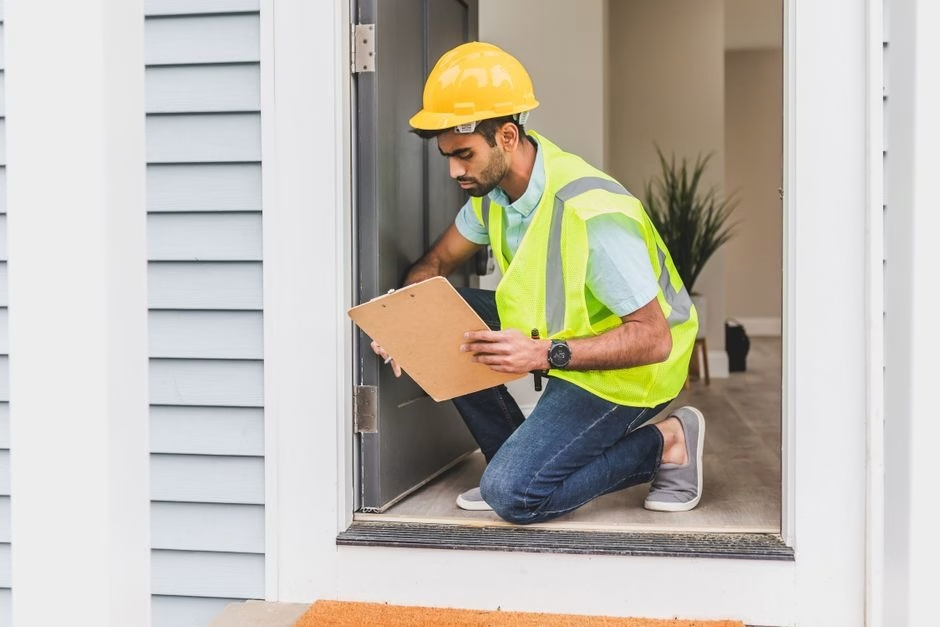
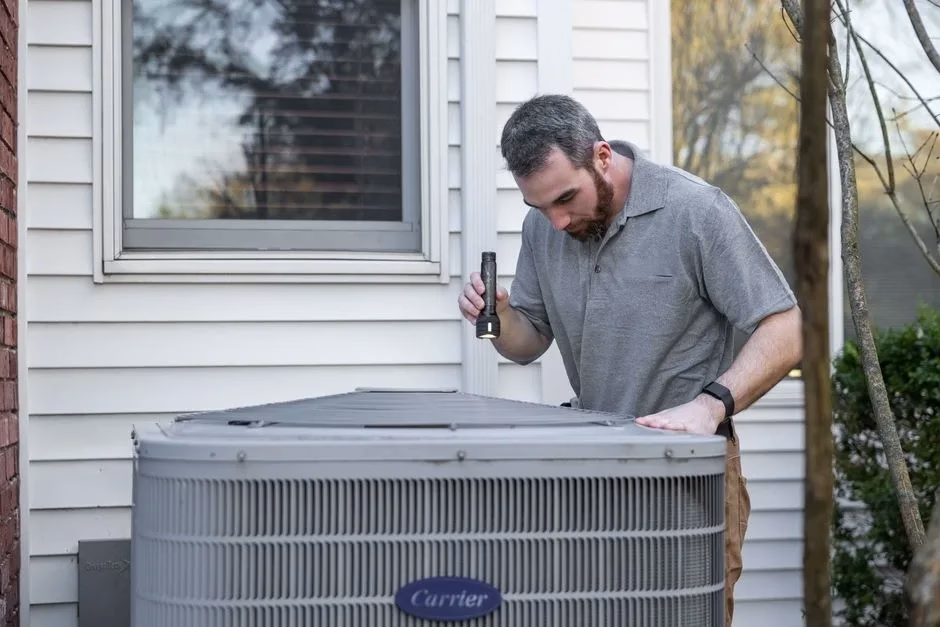
The most reliable way to assess your system’s true condition is through a professional evaluation by a licensed technician. A qualified inspector can measure airflow, check refrigerant levels, evaluate ductwork integrity, and identify efficiency losses that aren’t visible to the untrained eye. That diagnostic data gives you an accurate baseline for deciding whether to repair, upgrade individual components, or replace the system entirely.
The Best HVAC Upgrades to Consider for Year-Round Comfort
Once you’ve assessed your current system’s condition, the next step is understanding which upgrades will deliver the most meaningful improvement in comfort and efficiency. Not every upgrade makes sense for every home, but there are several options that consistently provide strong returns — both in terms of energy savings and day-to-day comfort.
Smart Thermostats and Connected Controls
For many homeowners, upgrading to a smart thermostat is the most accessible and immediately impactful change they can make. Modern smart thermostats go well beyond simple programmable scheduling. They learn your household’s patterns over time, adjust setpoints automatically based on occupancy, and can respond to real-time weather data to optimize performance.
Features like geofencing allow the thermostat to detect when you’re on your way home and begin conditioning the space before you arrive — without wasting energy when the house is empty. Demand-response integration connects your system to utility programs that can reduce energy use during peak grid demand periods, sometimes earning bill credits in return.
Voice assistant compatibility, humidity control settings, and filter replacement reminders make these devices genuinely useful tools rather than just novelties. When paired with variable-speed HVAC systems, smart thermostats can fine-tune output to match actual load conditions rather than simply switching between full-on and full-off — which is where the real efficiency gains come from.
Industry data suggests that smart thermostat adoption alone can reduce energy use by somewhere between 8% and 15%, making it one of the highest-value upgrades relative to its cost.
High-Efficiency Furnaces, Heat Pumps, and Ductless Systems
For homeowners ready to invest in equipment-level upgrades, high-efficiency systems represent the most significant opportunity for long-term savings and comfort improvement.
Heat pumps have become increasingly popular, and for good reason. Rather than generating heat through combustion, they transfer heat between indoor and outdoor environments — a process that requires significantly less energy. Modern heat pumps are rated using the HSPF2 (Heating Seasonal Performance Factor) metric for heating efficiency and SEER2 (Seasonal Energy Efficiency Ratio) for cooling. Higher ratings in both categories mean lower operating costs over time.
In Florida’s climate, heat pumps are particularly well-suited because they can handle both heating and cooling from a single system. For homeowners interested in eco-friendly options, Energy Star-rated heat pumps meet strict efficiency criteria set by the EPA and can meaningfully reduce both energy consumption and carbon footprint.
Ductless mini-split systems are worth considering for homes without existing ductwork, for room additions, or for creating independent comfort zones in specific areas of the home. Because they deliver conditioned air directly to the space without traveling through ducts, they eliminate the energy losses that ducted systems can experience — sometimes as much as 20–30% of conditioned air is lost in leaky ductwork.
Zoning systems take this concept further by dividing a home into independently controlled areas, each with its own thermostat. This means you’re only conditioning the spaces that are actually occupied, which reduces waste and improves comfort simultaneously.
For furnace replacements, the key metric is AFUE (Annual Fuel Utilization Efficiency) — a measure of how effectively the furnace converts fuel into usable heat. High-efficiency furnaces with AFUE ratings of 90% or above waste significantly less energy than older models that may be operating at 60–70% efficiency.
Filtration and Indoor Air Quality Improvements
HVAC upgrades aren’t limited to the mechanical systems that heat and cool your home. The filtration and air quality components of your system have a direct impact on both comfort and health — and they’re often overlooked until a problem becomes obvious.
Upgrading from a basic fiberglass filter to a pleated MERV 8–13 filter significantly improves the system’s ability to capture fine particles including dust, pollen, pet dander, and mold spores. Media cabinet filters offer high surface area with a lower pressure drop than high-MERV panel filters, making them a practical choice for most residential systems.
Whole-home HEPA filtration is an option for households with specific air quality concerns, though it requires careful evaluation to ensure the system can handle the increased static pressure without straining airflow.
One important consideration: filtration upgrades need to be balanced against your system’s airflow capacity. An overly restrictive filter can reduce airflow, cause the system to work harder, and ultimately shorten equipment life. A licensed technician can measure static pressure and recommend the appropriate MERV rating for your specific setup.
Beyond filters, whole-home dehumidifiers and air purifiers can address humidity-related comfort issues and airborne contaminants that standard filtration doesn’t fully address — both of which are particularly relevant in Florida’s humid climate.
Most pleated filters should be replaced every 60 to 90 days, while media filters typically last 6 to 12 months. Using your smart thermostat to set filter replacement reminders is a simple way to stay on schedule.
Planning HVAC Upgrades to Maximize Energy Savings
Upgrading your equipment is only part of the equation. To capture the full potential of a more efficient system, it’s worth addressing the building envelope and ductwork conditions that affect how hard your HVAC has to work in the first place. According to the U.S. Department of Energy, upgrading to a high-efficiency system combined with duct sealing and weatherization can reduce heating and cooling costs by 20% to 50% — a range that reflects how much the surrounding conditions matter.
Seal Air Leaks and Improve Insulation
Even the most efficient HVAC system will struggle to maintain comfortable temperatures if conditioned air is escaping through gaps in the building envelope. Common problem areas include gaps around window frames and door edges, penetrations in the ceiling and walls where pipes or wires pass through, and poorly sealed duct connections in unconditioned spaces like attics and crawl spaces.
Weatherstripping around doors and caulking around windows are low-cost interventions that can meaningfully reduce infiltration. In Florida homes, attic insulation is particularly important — an under-insulated attic allows heat to radiate downward into living spaces, forcing the cooling system to work continuously to compensate.
Improving wall insulation and sealing duct leaks can reduce the effective load on your HVAC system, which means it runs shorter cycles, experiences less wear, and consumes less energy to achieve the same level of comfort.
Whole-System Upgrades vs. Single Component Replacement
When a single component fails — a compressor, a blower motor, a heat exchanger — it can be tempting to replace only that part and move on. In some cases, that’s the right call. But in many situations, particularly with older systems, replacing one component without addressing the rest of the system creates a compatibility mismatch that limits efficiency and reliability.
Modern HVAC components are designed to work together as integrated systems. Pairing a new high-efficiency compressor with an aging air handler that wasn’t designed for variable-speed operation, for example, means you won’t capture the efficiency gains the new component is capable of delivering. In older systems where the technology has become largely obsolete, a whole-system upgrade typically delivers better long-term value than a series of piecemeal repairs.
For homeowners weighing these decisions, working with a licensed contractor who offers transparent, no-pressure guidance is essential. Resources like Nebula Home Services — which provides comprehensive heating and cooling solutions across Central Florida — can help homeowners understand their full range of options before committing to a repair or replacement path.
How to Build a Smart HVAC Upgrade Plan Step by Step
A well-structured upgrade plan does more than identify what needs to be replaced. It sequences improvements strategically, aligns with your budget, and minimizes disruption to your household. Whether you’re planning a single upgrade or a phased overhaul of your entire system, the approach matters as much as the equipment you choose.
Start With a Professional Diagnostic Inspection
Every effective upgrade plan begins with accurate information about your current system’s condition. A professional diagnostic inspection goes beyond a visual check — it includes measuring airflow at supply and return registers, evaluating refrigerant charge, inspecting ductwork for leaks and obstructions, testing thermostat calibration, and assessing the condition of key mechanical components.
This kind of performance audit gives you a clear picture of where efficiency losses are occurring and which components are approaching the end of their reliable service life. It also identifies issues that might not yet be causing obvious symptoms but could lead to failures down the road.
Ductwork condition is particularly worth evaluating. Leaky or poorly insulated ducts can account for a significant portion of your system’s energy losses, and addressing them before installing new equipment ensures that your upgrade investment isn’t undermined by distribution inefficiencies.
Working with fully licensed and insured professionals for this inspection is important — not just for safety, but because a qualified technician will have the tools and training to measure what matters rather than relying on visual estimates.
Planning HVAC Upgrades in Phases for Minimal Disruption
Not every upgrade needs to happen at once. In fact, a phased approach is often the smarter strategy — both financially and practically. By prioritizing the upgrades that deliver the greatest immediate impact, you can improve comfort and efficiency now while spreading the investment over time.
A typical phased plan might look like this:
- Phase 1: Smart thermostat installation and filtration upgrade — low cost, immediate impact, no major installation disruption
- Phase 2: Duct sealing and insulation improvements — addresses the building envelope before investing in new equipment
- Phase 3: Equipment replacement — new heat pump, furnace, or ductless system installed with the confidence that the surrounding conditions support peak performance
This sequencing also makes financial sense. Addressing air leaks and ductwork before replacing equipment means your new system is sized and specified based on the home’s actual, improved load — not the inflated load created by a leaky envelope.
Treating your HVAC system as a long-term asset rather than a reactive expense is the mindset shift that separates homeowners who consistently get good value from their systems from those who find themselves in emergency replacement situations at the worst possible time. Strategic timing — scheduling upgrades before peak season demand rather than during it — also gives you more control over costs and contractor availability.
Rebates, Financing, and Incentives Worth Knowing About
The upfront cost of HVAC upgrades is one of the most common reasons homeowners delay action — but there are often more financial resources available than people realize. Understanding what incentives exist, and how to access them, can meaningfully reduce the net cost of an upgrade.
How to Take Advantage of Available Incentives
Federal programs tied to energy efficiency improvements have made high-efficiency heat pumps and ENERGY STAR-rated equipment eligible for tax credits and rebates in recent years. The specific amounts and eligibility requirements can change, so it’s worth checking current program details before making a purchasing decision — what’s available at the time of purchase matters more than what was available when you started researching.
Utility rebates are another frequently overlooked resource. Many electric and gas utilities offer cash-back incentives for customers who install qualifying high-efficiency equipment. These programs vary by provider and region, and they can sometimes be combined with federal or state-level incentives to meaningfully offset equipment costs.
When stacking multiple incentive sources, it’s important to verify eligibility requirements for each program individually — some have income thresholds, equipment specification requirements, or contractor certification requirements that affect whether a particular installation qualifies.
Beyond incentives, financing options can make larger upgrades more accessible by spreading the cost over time. Many HVAC contractors offer financing packages tailored to different budgets, and some manufacturers offer promotional financing through authorized dealers. Warranty packages — including labor warranties that cover installation workmanship — are also worth factoring into the total value comparison between different contractors and equipment options.
Maintenance plans represent another form of long-term financial protection. A plan that includes regular inspections, priority service scheduling, and discounted repair rates can prevent the kind of deferred maintenance that leads to premature system failure and expensive emergency replacements.
Frequently Asked Questions About Planning HVAC Upgrades
How do I know if my HVAC system needs repair or full replacement?
The answer depends on a combination of factors: system age, repair frequency, and energy bill trends. As a general guideline, if your system is between 10 and 15 years old and has required multiple repairs in recent years, the cost-benefit math often favors replacement over continued repair. A professional evaluation is the most reliable way to make this determination — a licensed technician can assess actual performance data and give you an honest comparison of repair costs versus the long-term savings of a new system.
What HVAC upgrades provide the fastest return on comfort and efficiency?
Smart thermostats consistently rank among the highest-value upgrades relative to their cost, with energy savings of 8–15% achievable through better scheduling and automation alone. High-efficiency heat pumps deliver strong returns in climates where both heating and cooling are needed throughout the year. Zoning systems and filtration upgrades also provide noticeable improvements in comfort and air quality without requiring full system replacement. Variable-speed systems, when paired with smart controls, offer some of the most significant efficiency gains available in modern residential HVAC.
How often should an HVAC system be professionally maintained after an upgrade?
Annual professional servicing is the standard recommendation for most residential HVAC systems. Ideally, this is scheduled before the season when the system will be working hardest — late spring for cooling systems in warm climates, and early fall for heating systems. Regular maintenance includes inspecting and cleaning key components, checking refrigerant levels, testing safety controls, and replacing or cleaning filters. Enrolling in a maintenance plan with your HVAC contractor can simplify this process by automating scheduling and ensuring priority service availability when you need it most.
Conclusion
Planning HVAC upgrades is one of the most impactful investments a homeowner can make — not just for immediate comfort, but for long-term energy savings, system reliability, and indoor air quality. The key is approaching the process proactively rather than reactively: assessing your system’s actual performance, understanding which upgrades deliver the greatest value for your specific situation, addressing the building envelope conditions that affect how hard your system has to work, and building a phased plan that aligns with your budget and timeline.
The difference between a well-planned upgrade and a reactive replacement is often thousands of dollars and months of unnecessary discomfort. By starting with a professional diagnostic inspection, prioritizing high-impact upgrades, and working with licensed professionals who provide transparent guidance, homeowners can take control of their comfort and their energy costs — on their own terms.
For Central Florida homeowners navigating these decisions, local expertise matters. A contractor who understands the specific demands of Florida’s climate — the heat, the humidity, and the year-round cooling load — is better positioned to recommend the right equipment and the right approach than a generalist working from a catalog. Whether you’re considering a smart thermostat, a new heat pump, or a full system replacement, the goal is the same: year-round comfort that doesn’t cost more than it should.