
KDArchitects Landscape Ideas by Morph That Actually Work (2026 Guide)

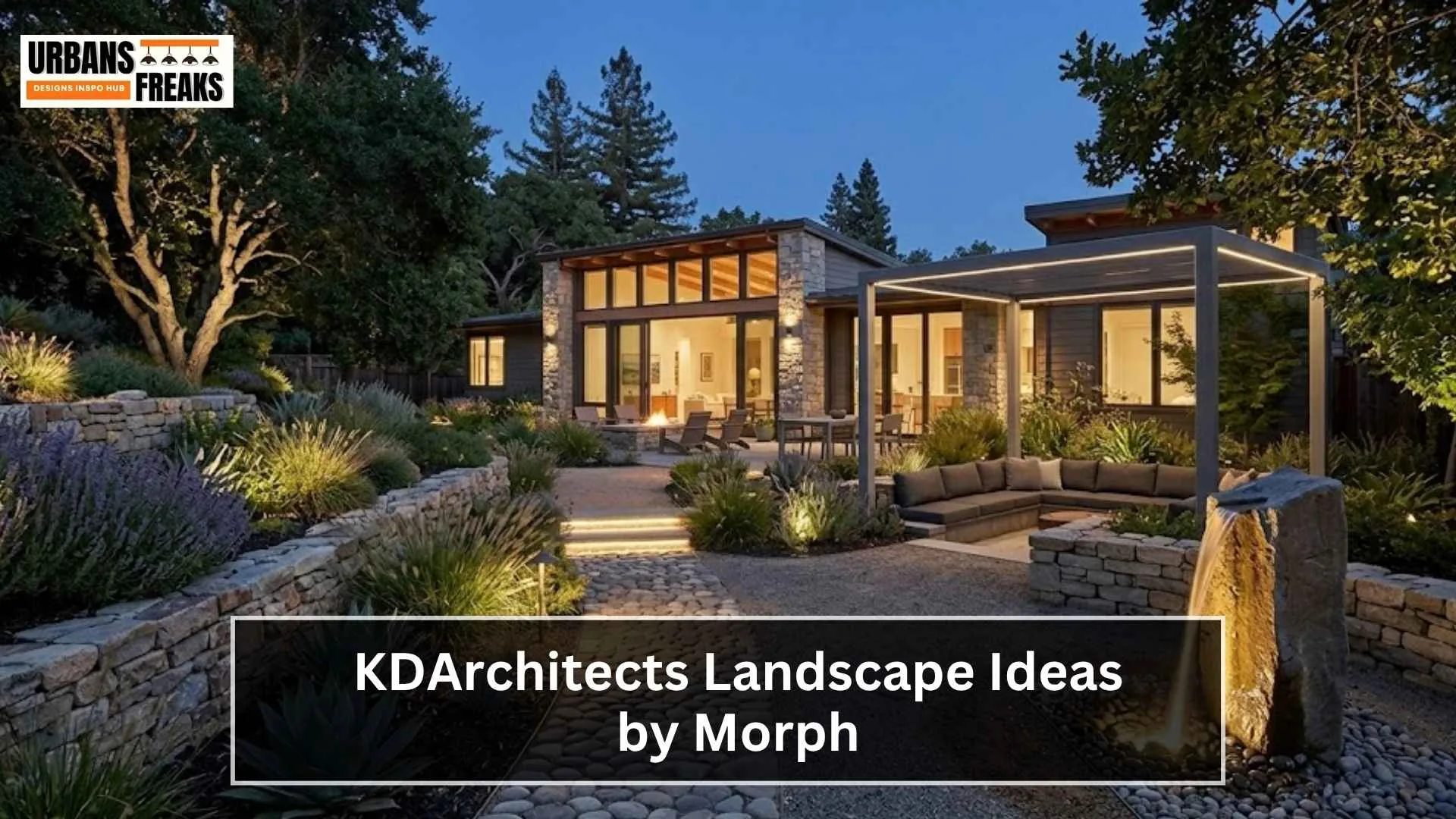
Most yards I’ve visited over the years have the same problem. They look like an afterthought: a flat lawn, a few shrubs pushed against the fence, and a concrete slab calling itself a patio. The house gets all the design attention. The land around it gets ignored.
That’s the exact problem Roger Morph at KDArchitects has spent his career solving. His approach to landscape architecture treats the outdoor space with the same discipline and intention you’d give to any well-designed room. At UrbanSFreaks, we cover design that adds lasting value to how people actually live, and this topic is worth a thorough, honest look.
Here’s everything you need to know about KDArchitects landscape ideas by Morph, from core philosophy to practical application in 2026.
Who Is Roger Morph and Why Do His Landscape Ideas Matter?
Roger Morph is the landscape design lead at KDArchitects, a firm known for site-specific, sustainability-driven work across the United States. What separates Morph from most landscape designers is his background — he approaches land the way an architect approaches a building floor plan. Every slope, shadow line, and patch of soil gets studied before a single plant is specified or a stone is laid.
His work is not about replicating a Pinterest board. It’s about reading what a site already wants to be and guiding it there with intention. That’s a rare skill in residential landscape work, and it’s why KDArchitects landscape ideas by Morph have drawn so much attention from homeowners, architects, and design publications alike.
The Core Design Philosophy: Work With the Land, Not Against It
The philosophy behind KDArchitects landscape ideas by Morph starts with one process: site reading. Before any design work begins, Morph’s team observes where the sun tracks across the property through the day, where water naturally pools after rain, how slopes and soil behave, and which existing trees or plants are worth keeping. This is standard in serious architectural work — but in most residential landscaping, it gets skipped entirely.
The result of that skip is a yard that fights its own environment and requires constant expensive intervention to stay alive. Morph’s site-reading process produces the opposite: landscapes that feel natural because they genuinely align with where they are, what the soil does, and how the light moves.
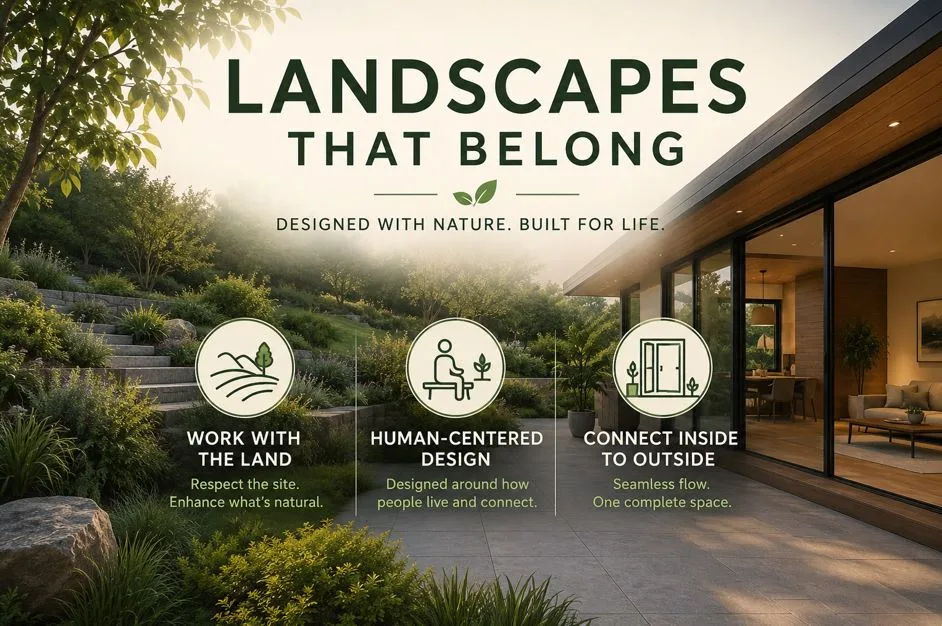
Working With the Land
If a natural slope exists, Morph uses terraced garden beds rather than expensive grading to make everything flat. If a corner is permanently shaded, it becomes a cool seating retreat rather than a dead zone where grass refuses to grow.
Human-Centered Thinking
Morph always asks: where do people naturally walk, sit, and gather? A design that ignores real human patterns creates a yard that looks good in photos but is never used. Every path, zone, and planted corner must serve daily life first.
Connecting Inside to Outside
Material continuity is one of Morph’s most effective moves. When stone, timber, or color flows from inside through glass doors onto a patio, both spaces feel larger and more finished. The boundary between architecture and landscape disappears.
Sustainable Landscaping: The Non-Negotiable Foundation
Sustainability is not a feature Morph adds to a project — it’s the starting point. Every KDArchitects landscape plan is built on practices that lower water use, reduce long-term maintenance costs, and support local ecosystems. In 2026, this matters more than ever.
The EPA estimates that outdoor water use accounts for up to 30% of household water consumption across the United States, with much of it wasted on turf grass poorly suited to local climates. Morph addresses this directly through regionally adapted plant choices, smart water systems, and soil-first design thinking that builds healthy, self-sustaining outdoor environments rather than high-maintenance showpieces that drain resources year after year.
Native Plants by Region
Native plants evolved in their specific region — they require less water, no chemical treatments, and support local wildlife naturally. Morph builds every plant palette around them.
| Region | Native Plant Choices |
| Southwest / Arizona | Agave, sagebrush, desert grasses, yucca, succulents |
| Midwest | Coneflowers, switchgrass, native sedges, prairie grasses |
| South / Texas | Live oaks, magnolias, gulf muhly grass, native wildflowers |
| Northwest / Seattle | Red ferns, Oregon grape, native willows, vine maple |
| Northeast / New York | Serviceberry, wild ginger, native asters, dogwood |
Xeriscaping for Dry Climates
In water-stressed states like Arizona, xeriscaping replaces thirsty turf with gravel, decomposed granite, and drought-tolerant plants like agave and desert grasses. Done well, xeriscape looks composed and textural — not barren or neglected.
Rain Gardens and Bioswales
In wetter regions — Seattle, Chicago, New York — Morph integrates rain gardens that capture stormwater, filter it through soil naturally, and return it to groundwater. They solve a real drainage problem while adding a beautiful planted feature to the yard.
Smart Irrigation Systems
When supplemental irrigation is needed, Morph specifies weather-responsive drip systems delivering water directly to root zones. This cuts irrigation waste by up to 50% compared to traditional sprinkler systems — a meaningful reduction in both cost and environmental impact.
Outdoor Living Spaces: Designing Rooms Without Roofs
One of the most practical and widely applicable ideas from Morph’s portfolio is the concept of the outdoor room. A yard isn’t just open space — it’s a series of zones, each with a distinct purpose, connected by clear paths of movement.
This directly mirrors how I think about interior floor plans. A well-organized yard has the same logic as a well-organized house.
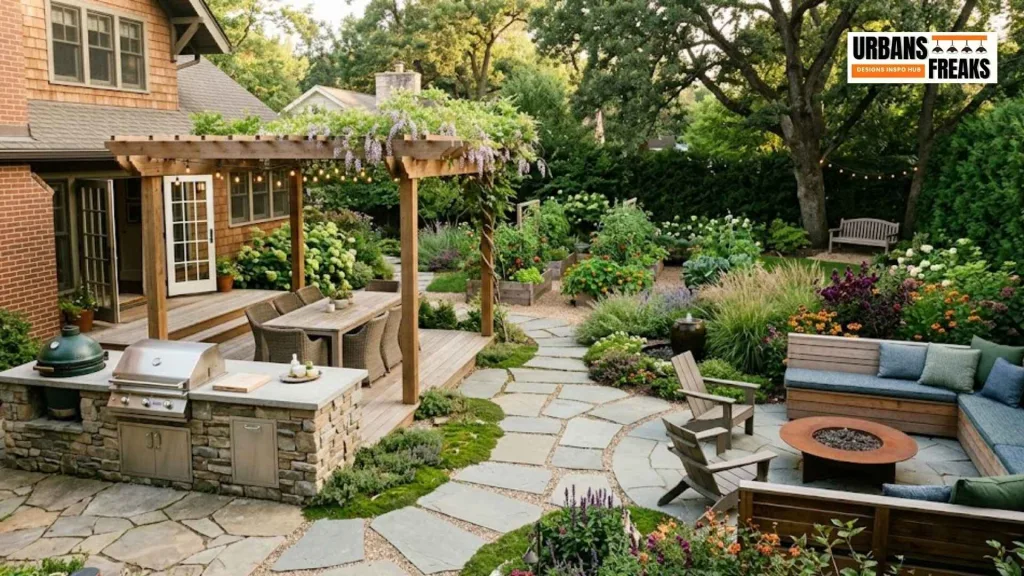
Zoning the Space
Morph divides outdoor spaces into functional areas rather than letting the yard exist as one undifferentiated expanse:
- Dining and cooking zone — A patio or deck, positioned for easy access from the kitchen, with an outdoor kitchen or grill station and weather-resistant seating. Pergolas or large shade trees define the overhead plane without fully enclosing it.
- Social and fire zone — A fire pit or outdoor fireplace with wraparound seating. In colder climates like the Midwest and Pacific Northwest, this zone extends the usable season well into autumn.
- Quiet retreat — A smaller, more tucked-away space — a bench under a tree, a reading nook behind a tall hedge, a hammock strung between live oaks. Every yard benefits from at least one place to sit alone.
- Garden and planting zone — Raised beds, kitchen gardens, or simply a carefully planted border. This is where seasonal color lives.
- Transition paths — Stone paths that move people deliberately through the space, slowing them down and encouraging them to notice the planting around them.
The connections between zones matter as much as the zones themselves. A well-placed stone path doesn’t just move you from point A to B — it creates the experience of the garden.
Bringing the Inside Out
One of the strongest visual moves in Morph’s work is the material continuity between interior and exterior. When the stone tile inside a living room continues through wide glass doors onto an exterior patio, the two spaces merge visually. The interior feels larger. The exterior feels more finished.
This connection — what designers call blending architecture with nature — is something I’ve used repeatedly in my own projects. It’s simple in concept but has an outsized impact on how both spaces feel.
Hardscaping: The Bones That Hold Everything Together
No matter how good the planting is, a yard without strong hardscape bones will always feel unresolved. Morph’s material choices reflect a commitment to quality, local sourcing, and longevity.
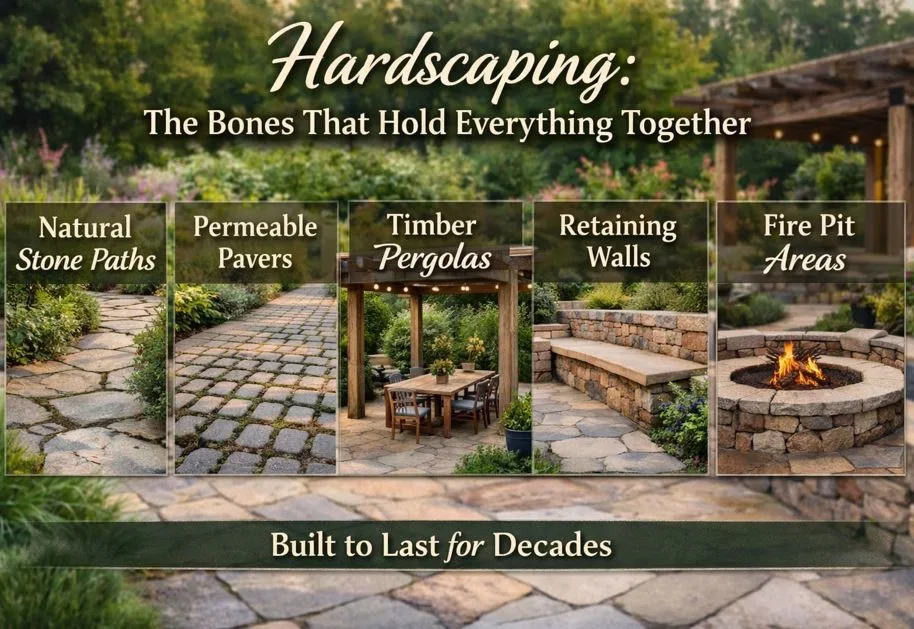
Common hardscape elements and their role:
- Natural stone paths — Durable, beautiful, and age well. Locally quarried stone ties the design to its region.
- Permeable pavers — Allow rain to percolate into the soil rather than run off. A functional and environmentally smart choice.
- Timber pergolas — Define outdoor dining and social areas. Reclaimed timber adds character and reduces embodied carbon.
- Retaining walls — Used on sloped sites to create level terraces. Can double as seating walls when built at the right height.
- Fire pit surrounds — Bluestone, sandstone, or poured concrete. The fire pit itself becomes an anchor point for the social zone.
The principle I’ve always applied — and that Morph’s work reinforces — is to spend well on hardscape. You do it once, and it defines the space for twenty or thirty years. Poor hardscape is expensive to fix later.
Minimalism in Landscape Design: One Strong Idea Per Zone
Morph’s aesthetic leans toward minimalism — clean lines, open space, one strong focal point rather than ten competing ones. This runs counter to the instinct most homeowners have, which is to fill every gap with something.
In practice, a single sculptural tree in a gravel field makes a stronger statement than a cluttered border packed with twenty different plant varieties. A long stone path with low ground cover on either side reads as elegant and intentional. The same distance covered in mixed shrubs of random heights just looks busy.
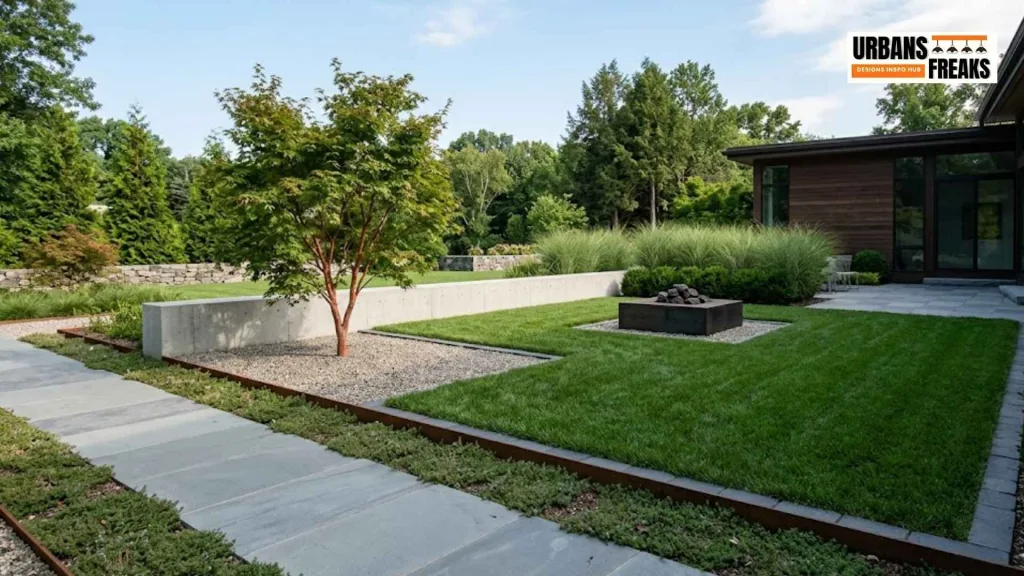
What minimalism in a yard actually means:
- Limit your plant palette — three to five species, used consistently, rather than one of everything
- Let the hardscape do structural work — paths, walls, and patios define space so plants don’t have to
- Choose one strong focal feature per zone — a specimen tree, a water element, a fire pit
- Keep lawn areas (if you have them) clean-edged and purposeful, not just leftover space
This approach also happens to be easier to maintain. Simpler planting schemes take less time to manage, and quality hardscaping lasts decades without much intervention.
Biophilic Design and Sensory Experience
There is strong research supporting what good landscape architects have always known intuitively: access to well-designed green spaces reduces stress, improves mood, and supports physical health. Studies published through institutions like the Harvard T.H. Chan School of Public Health have documented the health benefits of regular exposure to natural environments.
Morph’s work is explicitly biophilic — it is designed to maximize your sensory connection to the natural environment.
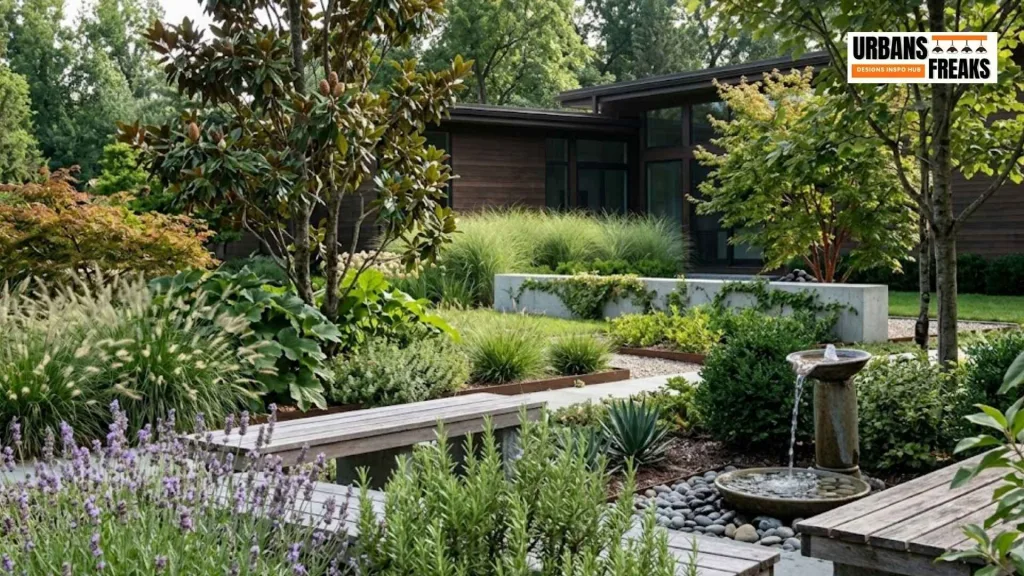
Visual Depth Through Layered Planting
This means engaging more than just sight:
- Sound — Moving water from a simple fountain or rain garden creates ambient noise that masks street traffic and signals calm
- Scent — Fragrant plants like lavender, rosemary, or native magnolias positioned near seating areas
- Touch — Varied textures in planting — smooth agave leaves, soft ornamental grasses, rough bark — that encourage you to slow down and interact with the garden
- Movement — Ornamental grasses and light-canopy trees that respond visibly to wind, adding life and energy to the space
A yard designed this way doesn’t just look good in photos. It feels good to be in every day.
Lighting: How the Yard Performs at Night
A landscape that disappears at sunset is only half a design. Morph’s projects consistently include a considered lighting layer that extends the usability of outdoor spaces and creates a completely different atmosphere after dark.
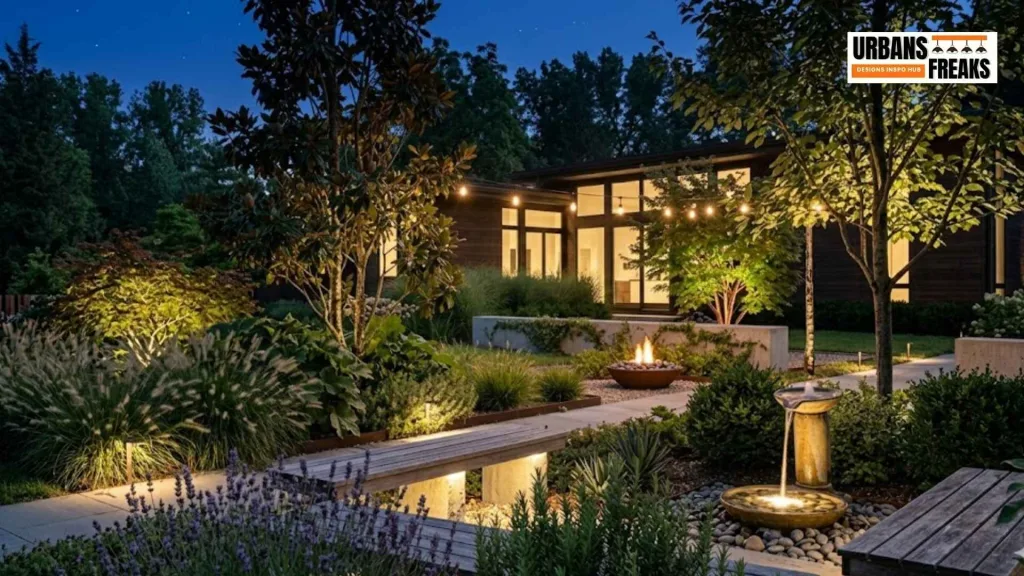
The three layers of landscape lighting:
- Ambient light — Soft overhead light from string lights, lanterns, or wall-mounted fixtures that establishes general visibility and mood
- Task light — Directed light at cooking areas, steps, and paths for safety and function
- Accent light — Uplighting on specimen trees, grazing light across a textured stone wall, or downlighting through a canopy to create shadow patterns on the ground
That last one — what Morph’s team has developed as a refined shadow play integration — is one of the most underused tools in residential landscape work. The way a light source positioned at the base of a mature oak throws branching patterns across a lawn at night is, frankly, stunning. It costs very little and transforms the after-dark experience of the space completely.
Garden and Plant Design Inspiration for 2026
Beyond sustainable plant selection, Morph brings genuine garden design thinking to planting layouts — color sequence, seasonal interest, and ecological function all play a role in how each plant is positioned and grouped. In 2026, the dominant trend in residential planting design is the shift from ornamental-only gardens toward ecologically functional planting schemes that also deliver strong visual structure.
Morph’s plant design philosophy bridges both goals: his gardens attract bees, butterflies, and birds while maintaining clear architectural structure and color interest across all four seasons. This dual function — beauty and ecology — is what makes his planting schemes genuinely different from conventional residential garden design.
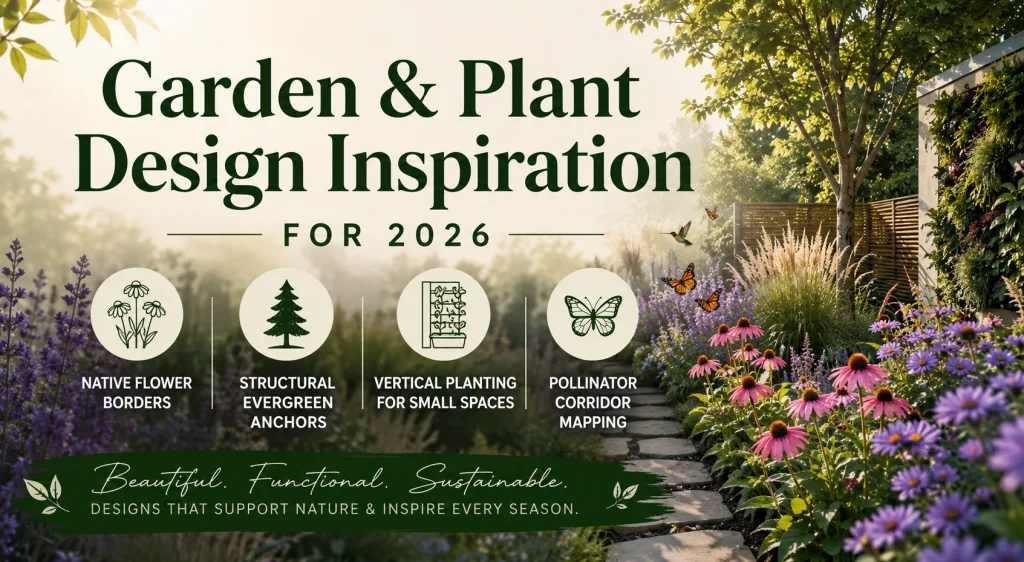
Colorful Native Flower Borders
Coneflowers, native asters, and prairie wildflowers deliver bold color from late spring through autumn. Planted in drifts rather than single specimens, they create movement and abundance that makes a border feel alive and generous rather than sparse.
Structural Evergreen Anchors
Live oaks in the South, magnolias along the East Coast, and desert grasses in the Southwest hold visual structure through winter. Evergreen anchors keep the landscape readable and composed year-round, regardless of season.
Vertical Planting for Small Urban Spaces
In compact lots in New York and Chicago, climbing vines, wall-mounted planters, and living walls add greenery without consuming ground area. The eye moves upward, expanding the perceived scale of a tight urban yard significantly.
Pollinator Corridor Mapping
Morph places flowering natives in connected sequences across the yard so pollinators move through the entire space rather than clustering in one corner. Ecological function and beautiful layered planting delivered simultaneously through thoughtful placement.
Outdoor Living Spaces: Entertainment, Relaxation, and DIY Ideas
Outdoor living is one of the biggest drivers of home investment in 2026. According to the American Institute of Architects’ Home Design Trends Survey, 68% of residential architects reported increased client requests for structured outdoor living spaces this year — a new record.
Morph’s approach treats these areas with the same care as interior rooms: functional, comfortable, and connected to the home’s design language. Importantly, while professional design adds significant value, many of Morph’s core ideas translate directly into DIY projects that homeowners can execute independently and incrementally over time without requiring full landscape design services upfront.
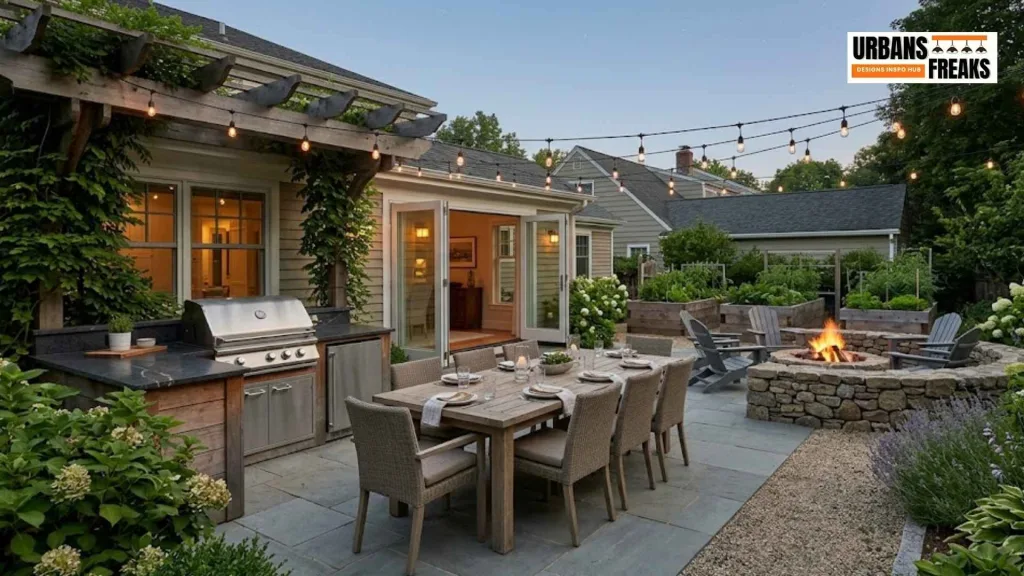
Outdoor Kitchen and Al Fresco Dining Areas
A built-in grill station, weather-resistant countertop, and dining seating under a pergola, positioned near the kitchen door for seamless indoor-outdoor flow during cooking and entertaining.
Fire Pit Seating Areas
A fire pit with a circular or semi-circular seating arrangement using local stone for the surround. Add moveable chairs and this becomes the most-used spot in the yard through three full seasons of the year.
Simple DIY Starting Points
Not every homeowner needs a design firm to begin. Here’s where to start using Morph’s logic:
- Lay a simple stone path from the door to the most-used area of the yard
- Add one specimen plant as a single focal point — a small tree or large ornamental grass
- Install one uplight at your best existing tree for immediate nighttime impact
- Build one raised bed and plant it with three native species for your region
Vertical Gardens for Urban Homes
Living walls or tiered wall planters on a fence or exterior surface. Affordable to build, visually strong, and particularly effective in tight urban yards in New York and Chicago where floor space is at a premium.
Budget-Friendly Makeover Moves
Rearranging existing plants into deliberate groupings, adding clean edging, updating to a single consistent paving material, or painting outdoor furniture can transform the quality of a space without major investment — and all reflect Morph’s core principles.
Adapting the Philosophy Across Different Property Types and Climates
One of the strongest qualities of Morph’s work is that the design philosophy stays consistent while the output changes completely by site. There is no signature look — there is a signature way of thinking, and it scales from a compact urban courtyard in Chicago to a multi-acre rural property in Texas with equal effectiveness.
This regional adaptability is what makes KDArchitects landscape ideas by Morph genuinely useful to homeowners across all parts of the United States rather than applying only to one property type, one climate zone, or one budget level. The thinking transfers; the materials, plants, and atmosphere adjust to match where you actually are.
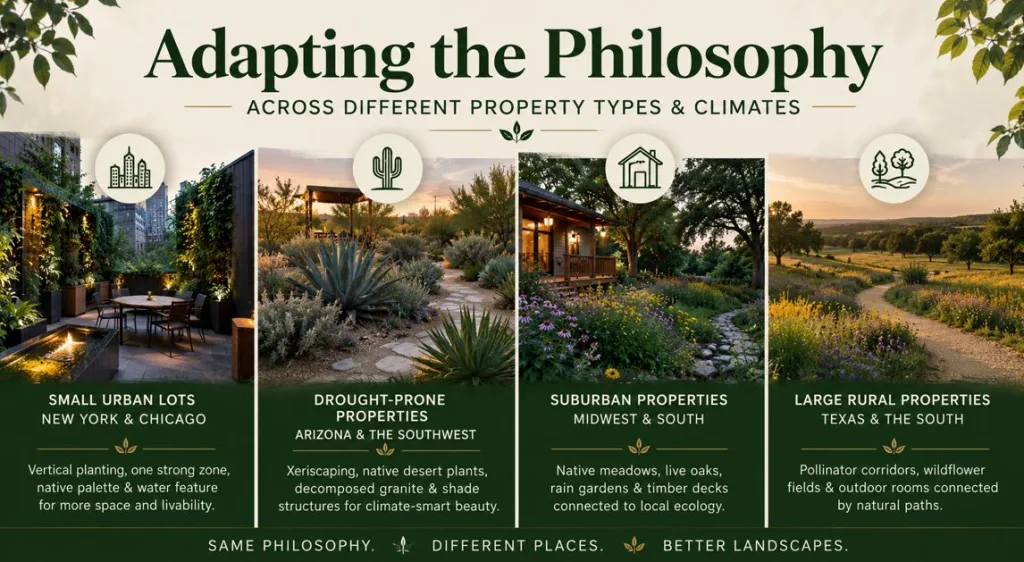
Small Urban Lots — New York and Chicago
Vertical planting, one strong central zone, a tight native plant palette, and a small water feature for sound. These moves make compact urban lots feel larger, more composed, and significantly more livable.
Drought-Prone Properties — Arizona and the Southwest
Xeriscaping, agave, sagebrush, desert grasses, a decomposed granite ground plane, and deep shade structures for afternoon relief. The design leans into the climate rather than spending money fighting it.
Suburban Properties — Midwest and South
Native meadow plantings, live oaks for structure, rain gardens along low edges, and a timber deck stepping down to the garden. These yards feel genuinely connected to their regional ecology in a way ornamental planting alone never achieves.
Large Rural Properties — Texas and the South
Expanded pollinator corridors, large-scale native meadow plantings, wildflower fields, and multiple distinct outdoor rooms connected by gravel or crusher-fines paths through the landscape. Scale is handled by creating human-sized zones within a larger natural framework.
Property Value and the Financial Case for Good Landscape Design
From a pure financial standpoint, landscape investment returns well. Professionally designed and maintained outdoor spaces consistently add measurable value to residential properties. This is especially true when the landscape design has clear structure — defined zones, quality hardscape, and mature plantings — rather than just lawn and a few shrubs.
Beyond resale value, there’s the daily return. A well-designed outdoor space is one you actually use. It extends your functional living area, gives you a reason to be outside, and contributes to your quality of life in ways that are harder to put a number on but very easy to feel.
If you’re exploring more ideas on how outdoor design connects to broader home decor principles, that relationship between interior and exterior design thinking is something we cover regularly here.
How to Start Applying These Ideas to Your Own Yard?
You don’t need a design firm to start thinking like Roger Morph. The principles are accessible. Here’s where I’d tell any homeowner to begin:
- Spend time observing before spending money — Watch where the sun hits, where water pools after rain, where you naturally tend to walk. That observation shapes everything.
- Pick two or three native plant species for your region — Start simple. You can always add later.
- Establish one clear focal point — A tree, a fire pit, a water element. Build the design outward from that.
- Invest in paths first — A well-placed stone path organizes a yard immediately and gives you a framework for everything else.
- Add one light source at night — An uplighted tree or a string of lights over a seating area changes the whole experience after dark.
These are small starting moves that reflect the same logic behind the most sophisticated landscape work. Good design scales down.
Final Thoughts
KDArchitects landscape ideas by Morph are not about achieving a particular style or replicating a portfolio image. They are about thinking clearly — reading a site, working with its natural systems, designing zones that serve real daily life, and choosing materials and plants that hold quality as the landscape matures over time.
That clarity of thinking is accessible to any homeowner willing to slow down, observe their land carefully, and resist the urge to fill every corner with something. Whether you start with a stone path, one native plant, or a single well-placed light — you’re applying the same logic Morph applies at full residential scale. Begin there, and the rest follows naturally.
Frequently Asked Questions
What are KDArchitects landscape ideas by Morph?
They are a set of site-specific, sustainability-driven landscape design principles developed by Roger Morph at KDArchitects. The approach emphasizes reading the land before designing, using native plants, creating functional outdoor zones, and connecting interior and exterior design with material continuity.
Is Roger Morph’s design approach suitable for small yards?
Yes. The philosophy scales down well. Vertical planting, one focal feature, a tight native plant palette, and a small water element can transform even a compact urban lot in New York or Chicago using the same thinking Morph applies to large properties.
How much can landscaping increase property value?
According to 2026 data from the National Association of Realtors, professionally designed landscapes can add 10–20% to a home’s value and reduce time on market. Structured outdoor living zones, quality hardscape, and mature plantings have the highest impact.
Can I apply Morph’s ideas without hiring a designer?
Yes. Start with a stone path, one focal plant specimen, one uplight on your best tree, and one raised bed planted with three native species for your region. These four moves reflect the core logic of Morph’s approach and can be done independently at modest cost.